
“Don’t Worry About It!”
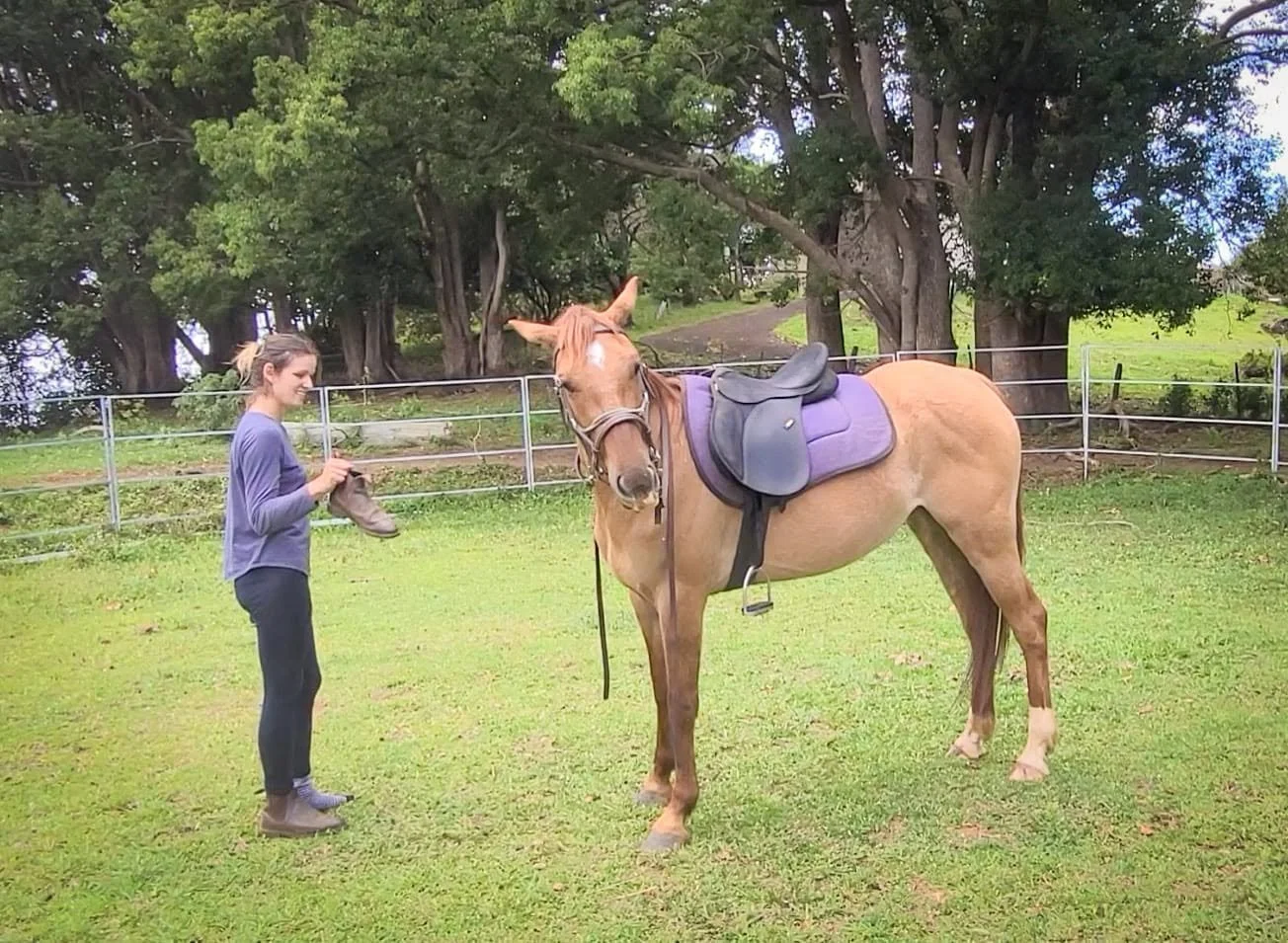
Sometimes there will be something going on that is off your radar, something that the horse is taking note of, but you aren't noticing at all. This is the bane of many horse's learning experiences, as riders will often say "it's just a ____! Don't worry about it!" I think we have all been guilty of that at some point or another.
What can seem insignificant to you, and even other horses, may be a real source of anxiety or fear for one particular horse.
Nala went through the beginning stages of being started under saddle amazingly, calm and improving with acceptance one step at a time. Once I got to sitting in the saddle, she was more than comfortable with that, and would happily stand quietly and relaxed. She would let me lean and touch all over her and reach her head around for a treat, no problem.
However, when she eventually turned and sniffed my boot, she was suddenly pushed over threshold and acted fearfully. As I've said in previous posts, if a horse performs an undesirable behaviour like spooking, bolting, bucking, etc, it is simply them showing you that they are being pushed over their threshold and that something that you're asking is too much for them to handle yet, and so go into flight or fight mode.
When you think of a horse being 'broken in', the whole point is for the rider to glue himself to the saddle and sit through whatever shit storm comes along until the horse gives up.
But in the same way that (when using new-age methods) you would remove a flag that is waving too close to the horses face for him to be comfortable with, to then hold it a little further away until he first gets used to it with that decreased pressure, the same goes for riding. If a horse shows levels of fear or anxiety that take him way out of his comfort zone, the best thing to do is go back a few steps. Get off, go back through what he was comfortable with, and try to isolate what the actual problem was that made him fearful.
In Nala's case, she didn't do anything 'naughty', just wanted to move away from my boot, but her fearful body language and huge change in energy was as loud and clear as a buck would be.
I wondered that her fear was either coming from the fact that these appendages were dangling either side of her, or perhaps it was something more specific. On the ground, I took my boot off and showed it to her, and there was our problem. She dashed backwards, snorting, terrified of this horse poo-smelling leather as though I were holding a snake.
So, armed with my terrifying boot, we forgot about saddle work for the moment and focussed on this fear. I have no idea why she was afraid of it, I don't think my feet smell quite disgusting enough to cause the reactions she was giving, but in any case, we spent the next 10 minutes with her at liberty, learning to accept that the boot was not going to get her.
I didn't put it to her face, or hold onto her rein to keep her there, I let it be completely up to her so that she could come back down from that state of fear on her own after each interaction.
After she was happy with it, I got back on, she sniffed my dangling, waving boot, and not an eye was bat.
Listening to your horse is so important. Rather than making assumptions based on what you think you know, or the behaviours of other horses (even if you've "been riding for 50 years and always done it this way!" *hoik* spit).
It's easy to want to take the less patient route and make the horse 'just deal with it' but, particularly with young horses, this usually ends up creating a lot more problems than it solves, does not make the horse think of you as a very good leader, and certainly not someone to be trusted through thick and thin.
